RPC usage and LAVA
News
Lava Foundation

Aug 20, 2026
.png)
Part one set out what a chain of Lava's own costs and asked whether it earns its keep. What follows is the position Lava Foundation reached, and the working behind it. It is a position, not a decision. Any change needs a governance vote, and none has been proposed yet. Two calls are made here, on what Lava becomes and on the kind of network that would host it. A third, which network, is left open.
One thing opened the question.
Lava runs on a support layer it neither sets nor influences. The wallets people hold tokens in. The tools for looking up what happened on the chain. The toolkit the chain itself is built from. All of it works today, and none of it is Lava's to steer. What has changed is how confidently anyone can forecast that support two years out.
Two further things encourage the change without being the reason for it.
Lava runs a modified version of the Cosmos toolkit, and every time the original moves on, engineers redo the modifications for nothing a user sees.
The validators and machines that run the chain, the rewards paid to keep them there, and the upgrades and maintenance on all of it.
Lava is better off as a protocol hosted by another chain. That is the Foundation's answer and the strongest finding in this evaluation. Staying is the baseline. It is not a solution, because it changes none of the three.
Two things are being compared, and only two. Lava as it runs today, a chain of its own with the rules written into the chain. Against the proposed change, Lava as a smart contract protocol, where the same rules are deployed as programs and hosted by another chain. On either one, Lava has contracts and no chain of its own.
The position is a smart contract protocol.
Lava's rules run as contracts. The chain goes.
What that would gain.
What that would cost.
Lava would still depend on infrastructure other people maintain. That layer is bigger, carried by many more teams, and closed to Lava's vote. How fast the network runs, how much it can be asked to do at once, and what using it costs all stop being Lava's to set. Lava would pay those costs in a token it does not issue. A bigger network defends the deposits, not the keys. Losing control of the keys that govern a protocol is one of the industry's largest causes of loss. Work the chain now does by itself, such as matching customers to providers, would need something outside it.
The judgement.
The Foundation has not put a full price on either side. What staying keeps is real: Lava sets its own rules about speed, cost and who pays for what, and answers to nobody for them. This evaluation values that below what leaving would return. Value it higher and the answer changes.
The same question has different answers for different products. Injective added contracts to its own chain in November 2025 and kept the chain. Noble announced in January 2026 that it was leaving the Cosmos toolkit, for a chain of its own rather than a home on anyone else's. Neither gave up a chain, and neither sells what Lava sells. On the Foundation's weighting, running one is no longer right for this network.
A family, here, is a way of writing programs that run on a blockchain. Two matter. EVM is the one Ethereum introduced and most other networks adopted. SVM is Solana's. Both families end the coordinated stops, retire the same 40,000 lines and need the same rebuild, so what is left to decide is the family, not any one network inside it.
Five things went into the comparison, each measured against the design the Foundation drew up to replace the chain. The first two are counts. The rest is judgement.
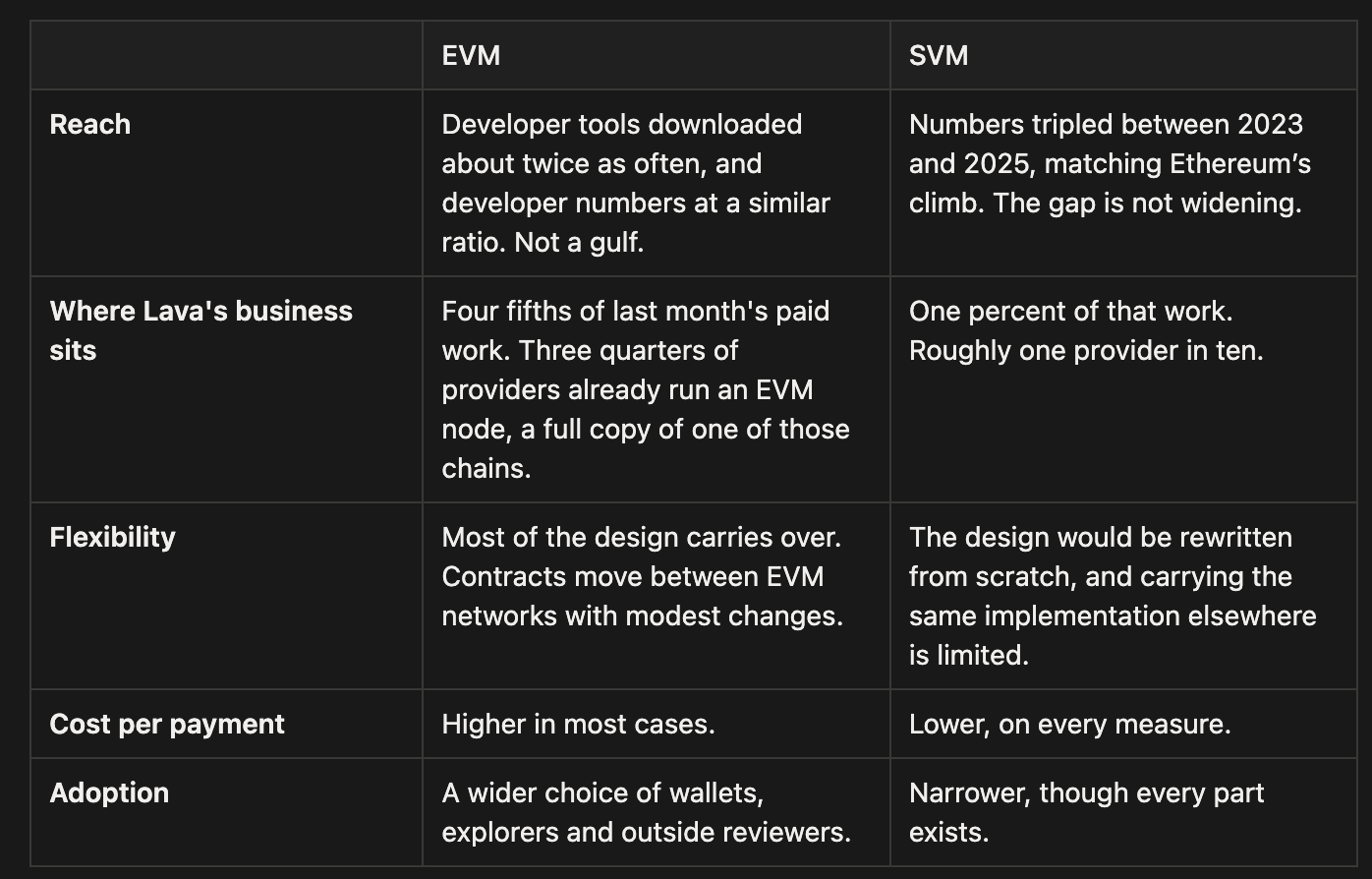
A reader who cares more about the cost of each payment than about reach lands on the other family.
The position is the EVM family. The Foundation weighs it ahead, and this finding is much thinner than the architecture one.
Five tests decide it, and a network has to pass all five.
The search covers both shapes of network, and nothing is excluded before the tests are run. An L1 keeps its own record and answers for it. An L2 handles activity itself and hands the record down to a larger network for safekeeping, which is one way to reach the cost and speed the design wants while keeping the protection of a large network underneath. Ethereum's own base layer stays on the list alongside the rest.
These five do not leave one network standing. Several would pass, and choosing among those turns on things the tests do not measure. No network has been picked, and that choice deserves a discussion of its own.
A rebuild reopens decisions that have stood since launch, and the review turned up several worth making on their own merits. None of them is a direct outcome of a move, and all of it could theoretically be done on Lava's own chain. What a rebuild does is put them within reach at once, which is a good reason to look hard at what else the protocol could do better.
Two examples:
Part one set out what Lava has built and how the ground under it moved, and it ended on one question: whether a chain of Lava's own still earns its keep. Part two answers it in three steps, and the confidence drops at each one. Lava is better off as a protocol hosted by another chain, which is the firm finding. The EVM family is the better place to host it, which is a closer call. Which network is not decided, and will not be until the tests are run against real candidates.
None of it is settled. Any change needs a governance vote, and none has been proposed yet. Until one is, this is an argument to be had rather than a plan to be carried out. If a step is wrong, or an option was treated unfairly, or the cost of leaving is understated, say so on the forum or at the session.