


Reopening Tokenomics: Usage, Demand, and the Assistance Fund
News
Lava Foundation

Oct 2, 2026

Lava was built to make blockchain access more open and reliable. Providers serve RPC requests, the protocol measures that work, and customers pay for the service. This article reopens tokenomics around a practical question: how can paid usage, provider compensation, and LAVA demand fit together while future choices remain open?
For context, we recommend reading the discussion in order: 1. What Is Built and One Open Question; 2. Part 2: Evaluating the Alternatives; 3. From RPC Usage to LAVA Demand. This article describes current mechanics, the evidence they produce, and a proposed framework for public consideration, not adopted policy.
The current model makes monthly Provider Drops and Validator Drops available up to defined quotas. These quotas are maximum amounts made available for the period, not guaranteed payouts.
Provider Drop balances: 20,625,000 LAVA remains in the allocation pool, and 1,375,000 LAVA is currently in the Provider distribution pool, for 22,000,000 LAVA in total remaining Provider reward funds. The monthly quota is 1,375,000 LAVA.
Validator Drop reserve at genesis: 34,000,000 LAVA; allocation remaining: 10,675,168.651512 LAVA; monthly quota: approximately 711,372 LAVA.
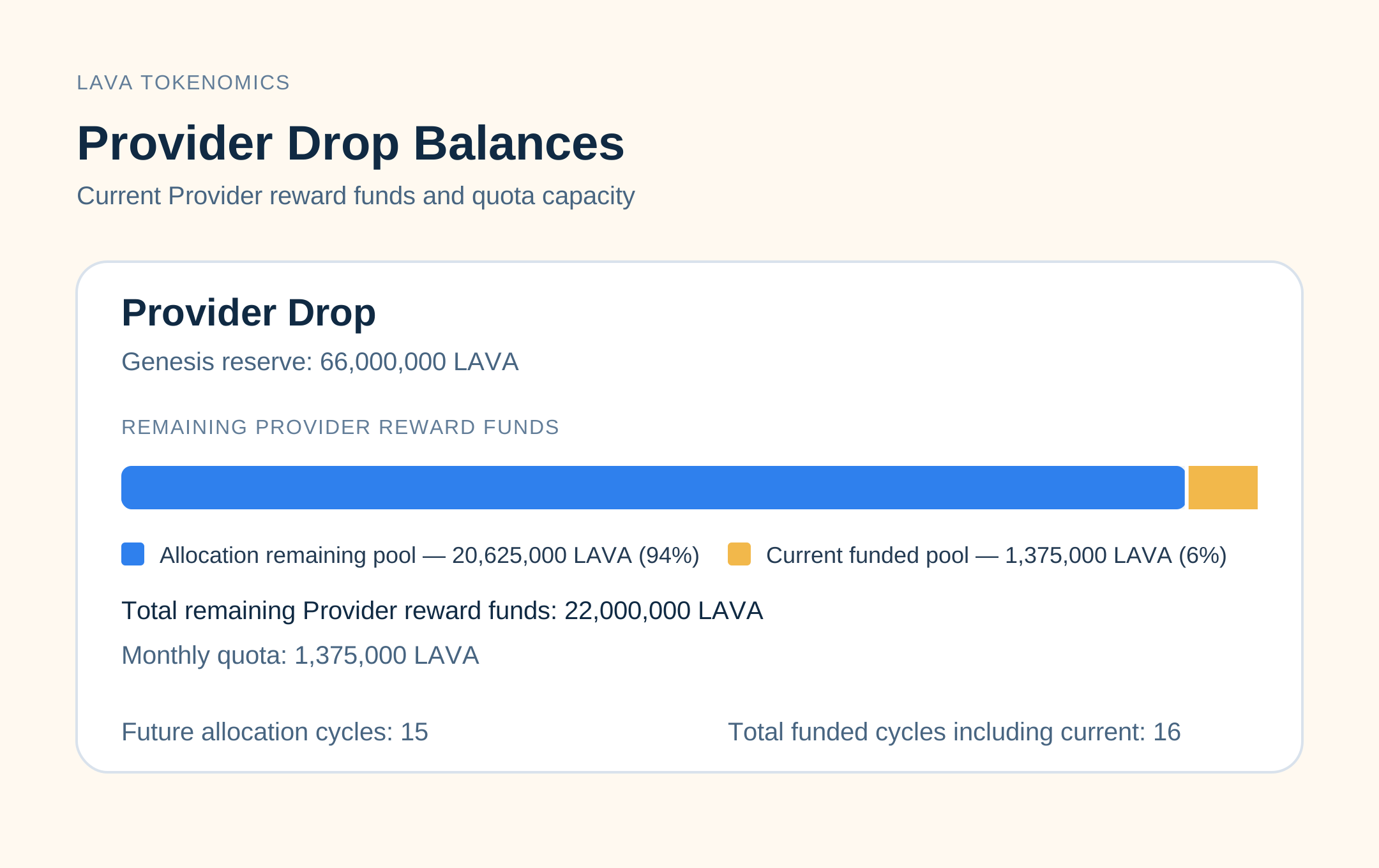
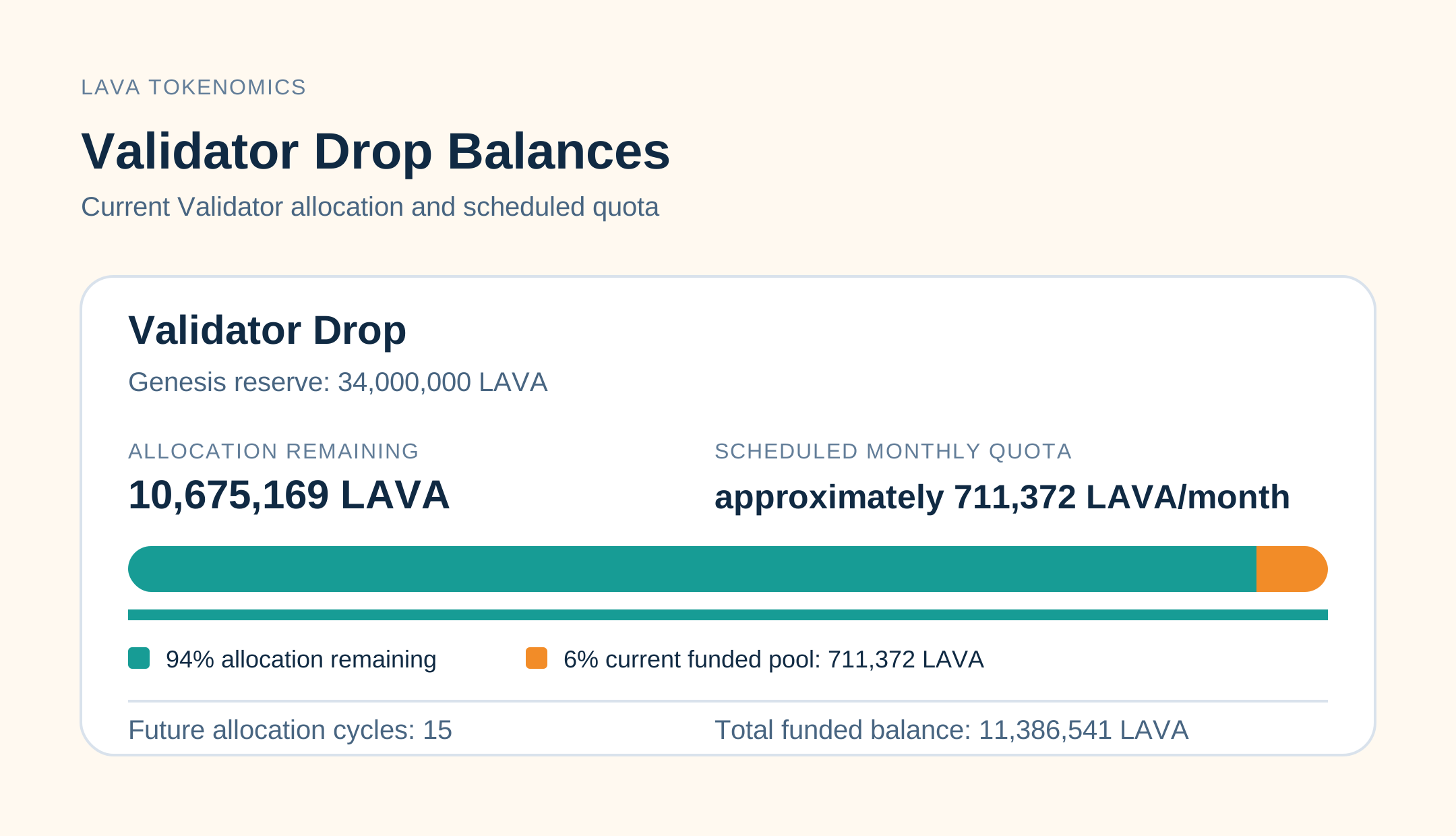
The remaining balances represent 15 future Provider allocations in the allocation pool. Including the 1,375,000 LAVA already in the current Provider distribution pool, 16 Provider quota cycles remain in total. This is scheduled quota capacity, not a forecast of actual distributions or a calendar end date.
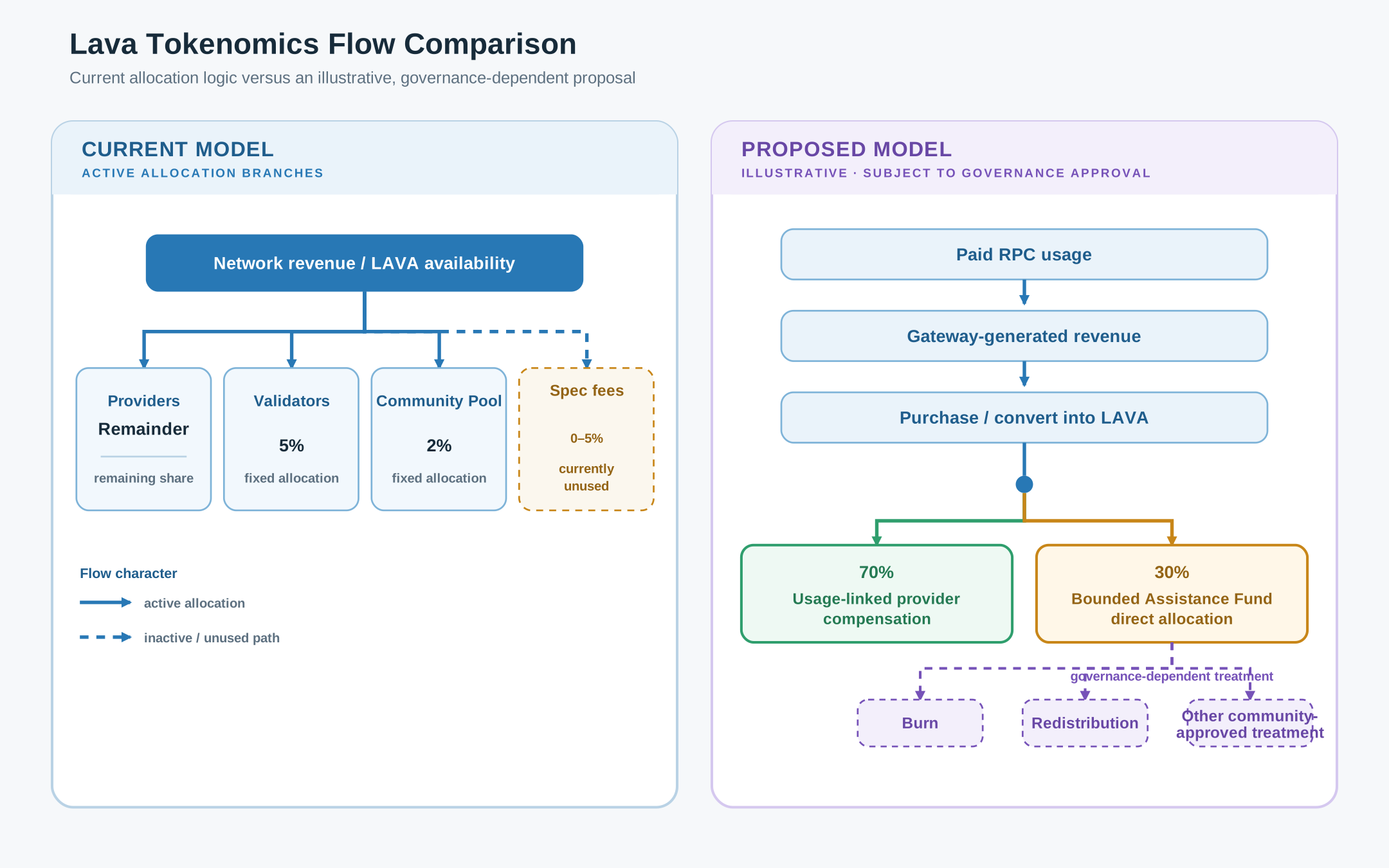
Current network revenue operates as one global flow: network revenue is used to purchase or convert into LAVA, and LAVA is made available monthly on the 17th. Under the current per-chain distribution, 5% goes to validators, 2% to the Community Pool, 0–5% may go to spec fees (currently not in use), and the remainder goes to providers.
The proposed architecture changes the distribution mechanism and it does not represent an adopted policy.
The foundation recommends an initial 70% allocation to provider support because providers bear the infrastructure costs that sustain RPC availability and service quality. In September 2026, providers received 39,145.895001 LAVA from the 1,375,000.000000 LAVA quota. The derived burn was 1,335,854.104999 LAVA: 2.8470% distributed and 97.1530% burned. This shows that the reserve-funded quota was substantially larger than the amount distributed under the mechanism; by itself, it does not measure provider activity, demand, profitability, service quality, or work performed. The remaining 30% would remain in the Assistance Fund, preserving flexibility for approved support or burn mechanisms. This is a starting policy recommendation, not a claim that the ratio has been proven optimal. If adopted as a protocol parameter, the allocation could be revised through an on-chain community vote.
With Lava’s architecture under review, this is the right moment to ensure tokenomics support the long-term interests of token holders, providers, contributors, users, and the network. If Lava adopts a no-owned-chain architecture, validator-specific allocations may no longer fit. More broadly, provider support should be tied more directly to actual paid usage and service quality than a reserve-funded quota alone can provide.
Each month, the system checks how many tokens remain in each reward distribution pool.
Provider Drops are paid out immediately before the monthly refill. Any tokens still remaining in the Provider distribution pool are then burned in full. The system calculates the next monthly quota from the allocation pool and transfers it into the distribution pool.
Validator Drops follow the same sequence: rewards are distributed, the remaining balance is burned, and the next quota is transferred. However, the Validator burn rate is configurable and defaults to 100%.
In both cases, the burned amount is the unused balance after distribution, not automatically the full monthly quota. Immediately before burning, the tokens are held in module-controlled reward accounts.
Unlock activity is included as a separate supply-side flow relevant to interpreting the broader tokenomics picture. Available data indicates that an average of 19,255,892 LAVA per month is being released through vesting or unlocking. Approximately 12,968,005 LAVA per month is attributed to tokenholders, with an approximate remainder of 6,287,887 LAVA per month attributed to the Lava Foundation allocation.
These figures represent average monthly amounts, not a point-in-time snapshot. They describe vesting or unlocking activity only and do not characterize subsequent market activity or market conditions. Unlock activity is separate from the Provider and Validator Drop amounts shown above, as well as from the distributions and burns associated with those programs.
The current tokenomics model remains active until governance formally adopts a replacement. Under the proposed architecture, all existing Provider Drops, Validator Drops, the 5% validator allocation, the 2% Community Pool allocation, and the 0–5% spec-fee allocation would be redirected into a bounded, on-chain Assistance Fund, subject to governance-defined rules and limits.
Usage-linked provider compensation may be introduced as a separate mechanism funded through Gateway-generated revenue. The proposed Gateway split is 30% to the Assistance Fund and 70% to providers, subject to governance approval.
The old allocations would therefore be added to the Assistance Fund under the proposed architecture.
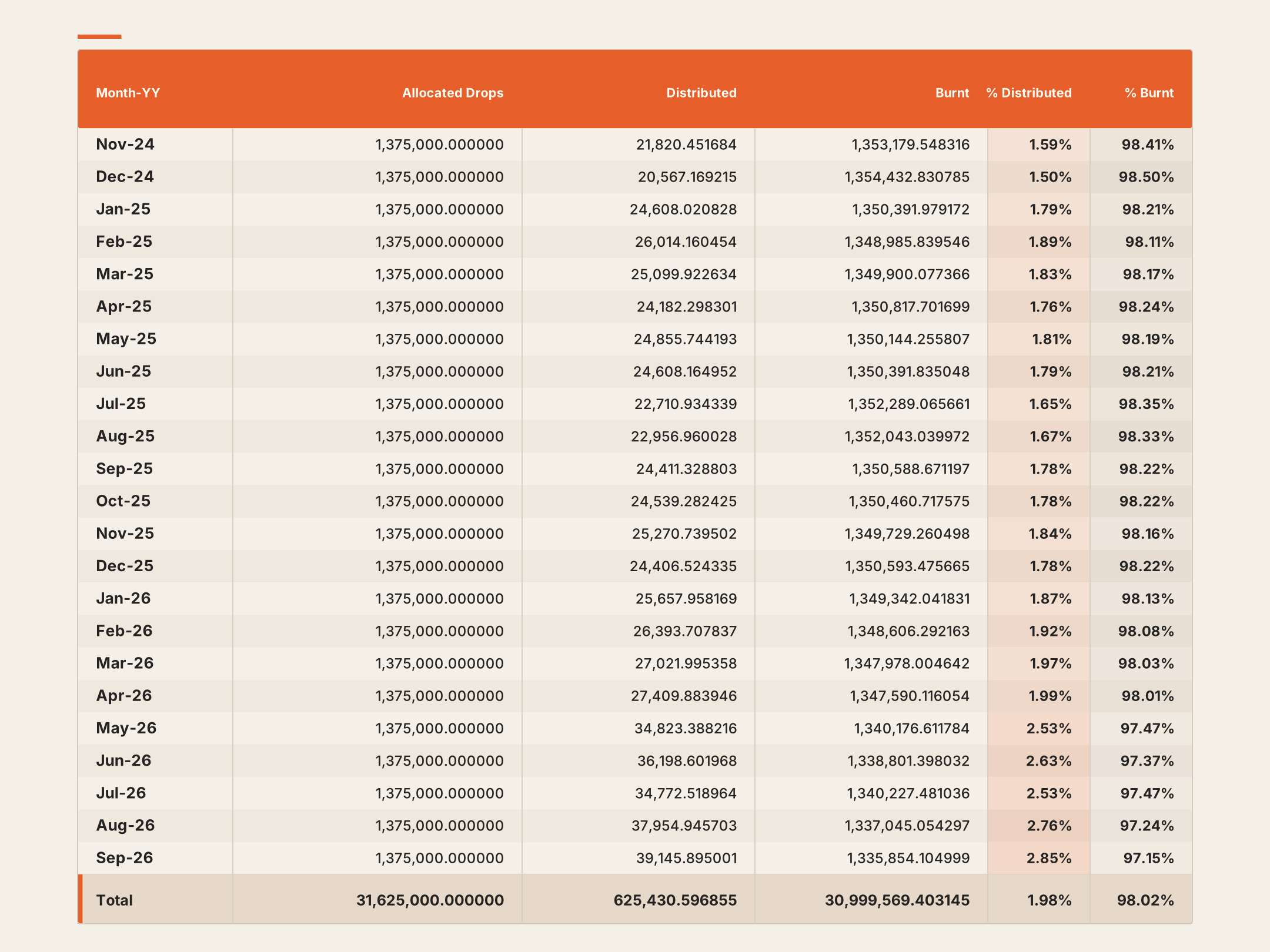
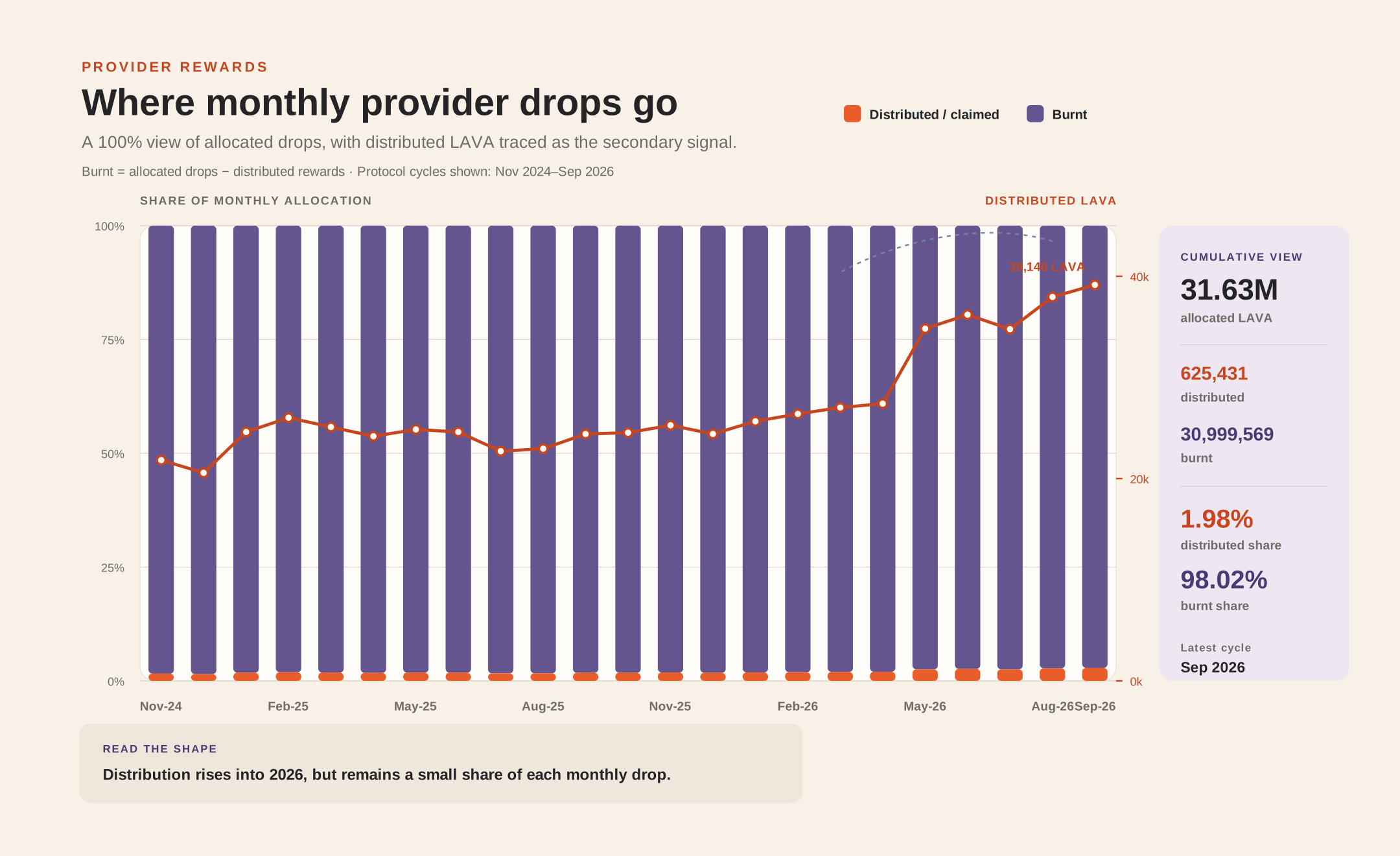
Provider Drops were introduced as a bootstrap mechanism. While Lava’s paid usage and provider economics were still developing, the protocol made a reserve-funded amount available to providers each cycle. Across the recorded Provider Drop ledger cycles from Nov-24 through Sep-26, the Provider Drops quota totaled 31,625,000 LAVA. Providers distributed or claimed 625,430.596855 LAVA, equivalent to approximately 1.9776% of the total quota. Based on the 100% burn rate, the derived burn was 30,999,569.403145 LAVA, or approximately 98.0224% of the total quota.
The recorded ledger shows that most quota was not distributed under the current mechanism.
The latest completed cycle reinforces this pattern. In September 2026, providers distributed 39,145.895001 LAVA from a 1,375,000 LAVA quota. The derived burn was 1,335,854.104999 LAVA, representing 2.8470% distributed and 97.1530% burned.
These burns were determined mechanically by the Provider Drop quota and refill rules. They do not measure provider activity, profitability, service quality, demand, uptime, or the amount of work performed. The burn pattern does not prove that providers did no work or that burned tokens were non-circulating. It shows that the reserve-funded authorization was substantially larger than the amount ultimately distributed under the mechanism’s rules.
Providers remain central to Lava’s RPC service. Compensation should therefore be more directly connected to actual service provision and usage, rather than repeatedly authorizing large reserve-funded quotas that are mostly burned at refill.
Subject to governance approval, the proposed redesign would replace reserve-funded Provider Drops with usage-linked provider compensation funded by Gateway-generated revenue. The aim is to evolve the bootstrap mechanism into a compensation model better aligned with delivered service, network usage, and realized economic activity.
The Foundation’s proposal under consideration is a visible flow: paid RPC usage creates protocol revenue; protocol revenue purchases LAVA; purchased LAVA supports usage-linked provider compensation and the Assistance Fund as one bounded component. The Assistance Fund would be a bounded, separately accounted, on-chain holding mechanism for Fund-held LAVA within the proposed tokenomics model. It is not a grants program, general treasury, operating budget, maintenance reserve, emergency reserve, or discretionary Foundation account. Its future purpose and disposition are not defined in this article and would be determined by the Lava ecosystem and community through a future public process. The Foundation may provide a recommendation for consideration, but would not decide unilaterally; burning, redistribution, or another community-approved treatment remain possible outcomes. The proposed model is subject to formal community consideration and adoption.
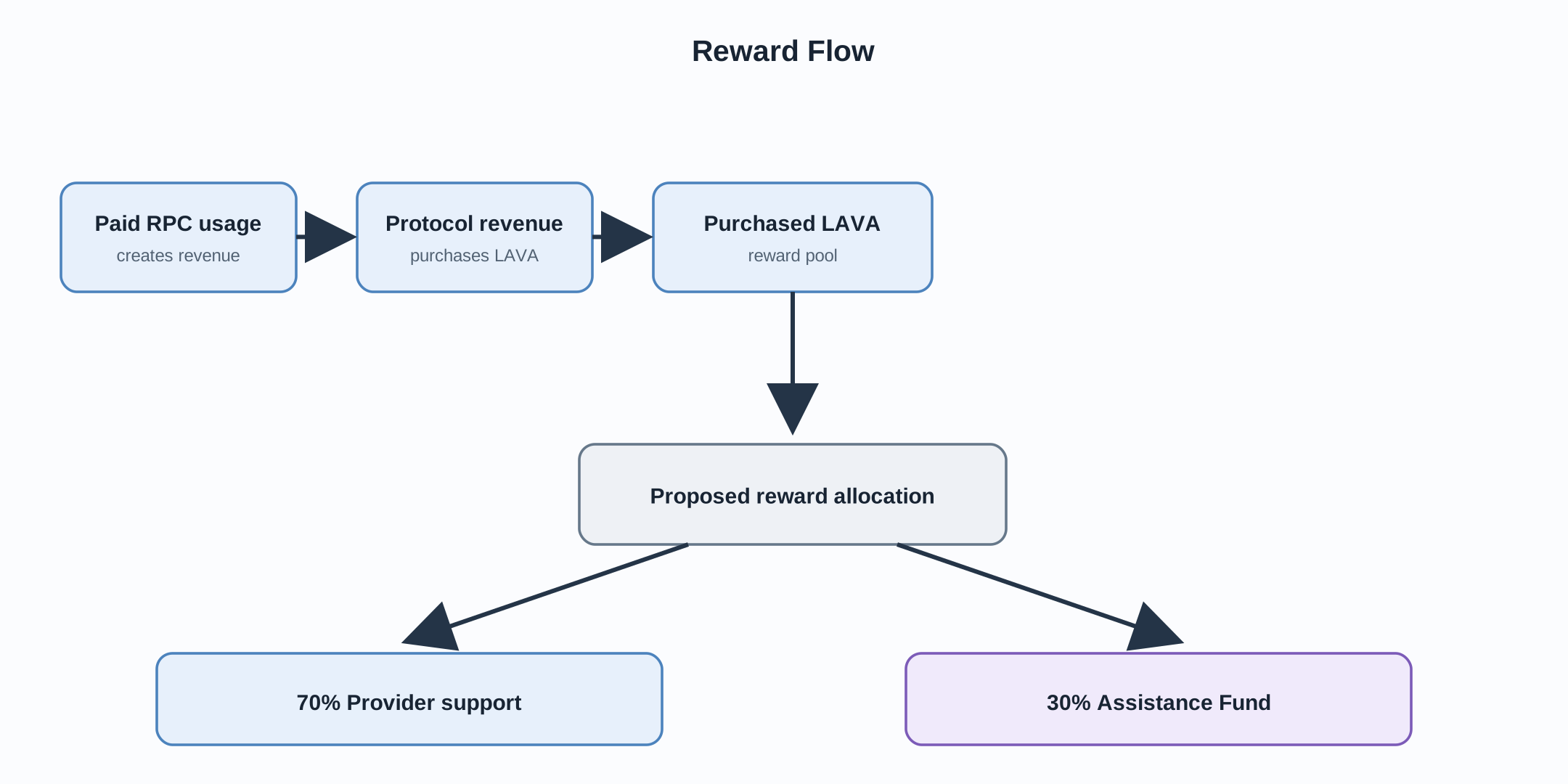
Gateway-generated revenue would be used to purchase LAVA. Of the purchased LAVA, 30% would enter a bounded, separately accounted, on-chain Assistance Fund, while 70% would support providers. The Fund’s treatment could include burn, distribution, or a combination determined through a future approved process.
The current model remains active until governance adopts a replacement. It uses the 5% validator allocation, 2% Community Pool allocation, 0–5% spec-fee allocation, Provider Drops, Validator Drops, and burns unused Drop balances at refill. Under the proposed architecture, these allocations and Drop mechanisms would be redirected into the bounded, on-chain Assistance Fund, subject to governance-defined rules and limits.
The current data points to a clear issue: monthly Drop quotas are reserve-funded capacity, while the latest Provider Drop burn shows that most of that capacity went unused. The answer is not to infer more than the data supports, but to design a more direct connection between paid usage, provider service, compensation, and LAVA demand.
The proposed model keeps the Assistance Fund bounded, separately accounted, and on-chain while preserving the community’s authority over its future. The Foundation may recommend; the Lava ecosystem and community decide. The goal is a transparent framework that can be tested, measured, and governed rather than a policy presented as settled before the formal process begins.




.png)